The 35-Year Hard Cap: Australia’s Structural Pivot on Research
Quick Summary
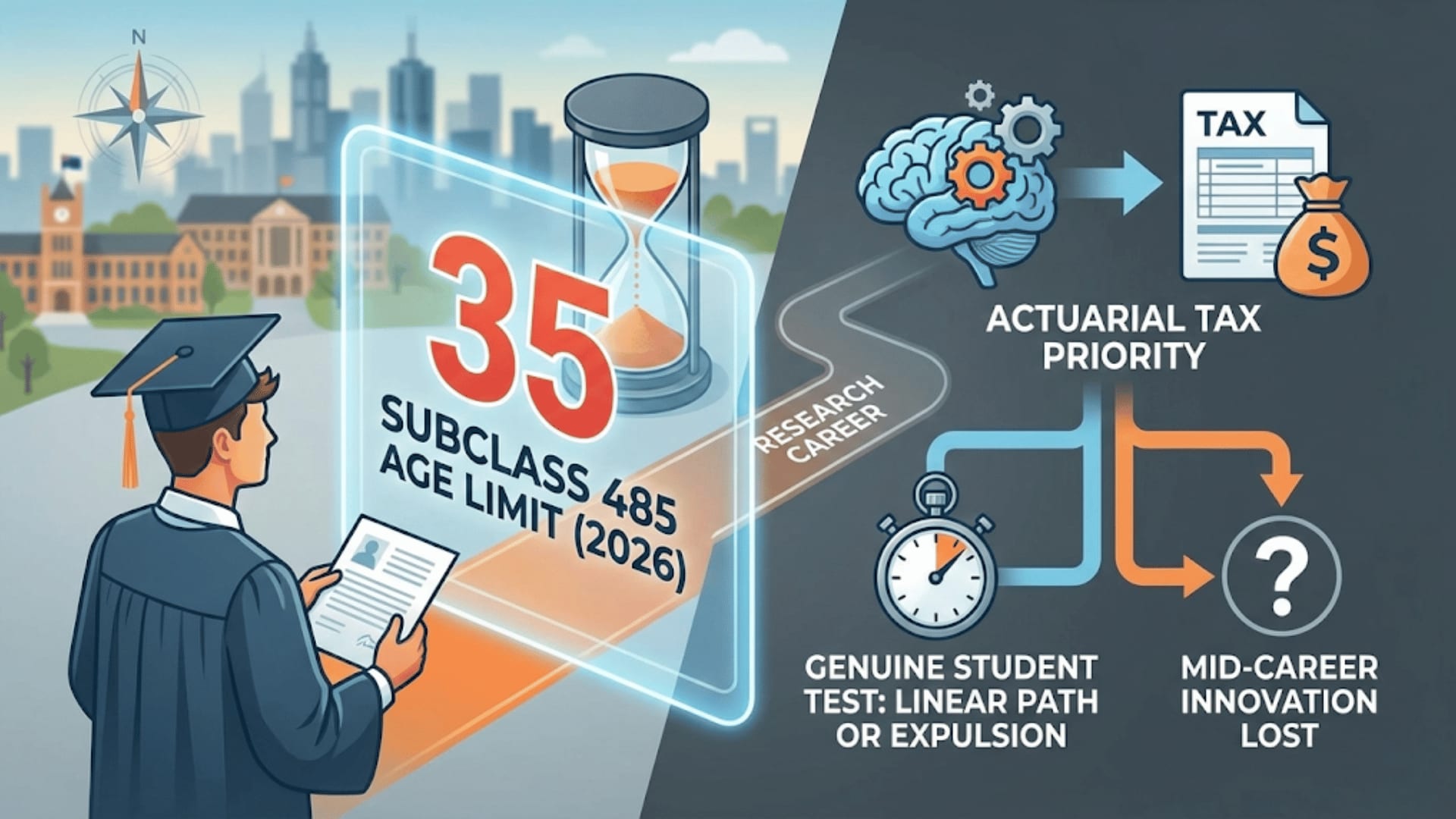
Quick Summary: An analysis of how Australia’s reduction of the graduate visa age limit to 35 is disrupting the PhD and research ecosystem.
The Era of Economic EfficiencyThe Era of Economic Efficiency
The most controversial part of Australia's Migration Strategy is the requirement that the age limit for Subclass 485 be lowered to 35 by 2026.The most controversial part of Australia's Migration Strategy is the requirement that the age limit for Subclass 485 be lowered to 35 by 2026. This is not just an age filter; it is a decision made by actuaries to give priority to migrants who will contribute to the tax base for at least 30 years before they retire.This is not just an age filter; it is a decision made by actuaries to give priority to migrants who will contribute to the tax base for at least 30 years before they retire. But the research field is where this logic's structural flaw is most clear.But the research field is where this logic's structural flaw is most clear. PhD students and post-doctoral researchers, who often don't finish their specialized training until their early 30s, now have their post-study work window effectively closed before it even starts.PhD students and post-doctoral researchers, who often don't finish their specialized training until their early 30s, now have their post-study work window effectively closed before it even starts.
The Departure of Specialized ResearchersThe Departure of Specialized Researchers
There is a quiet but big flow of high-level academic talent leaving Australian universities for Canada and Europe.There is a quiet but big flow of high-level academic talent leaving Australian universities for Canada and Europe. A 31-year-old researcher in Melbourne who starts a PhD program has no guarantee of a visa to stay in the country after their studies if their research takes longer than four years.A 31-year-old researcher in Melbourne who starts a PhD program has no guarantee of a visa to stay in the country after their studies if their research takes longer than four years. This has made Australia's higher education system a "short-degree" destination, which is bad for the country's tech and biotech industries because they need deep-research specialists for long-term growth.This has made Australia's higher education system a "short-degree" destination, which is bad for the country's tech and biotech industries because they need deep-research specialists for long-term growth.
The 35-Year Hard Barrier: Applications that are sent in one day after a person's 35th birthday are being automatically denied, even if there are "special circumstances" like maternity leave or medical delays.The 35-Year Hard Barrier: Applications that are sent in one day after a person's 35th birthday are being automatically denied, even if there are "special circumstances" like maternity leave or medical delays.
The Masters (Research) Trap: People who are getting their master's degrees in research are finding that the long wait times for degrees in Australia are making them too old to get them.The Masters (Research) Trap: People who are getting their master's degrees in research are finding that the long wait times for degrees in Australia are making them too old to get them.
Industry Backwash: Australian tech companies are having trouble finding senior R&D leaders because people who used to stay on graduate visas to start businesses now have to leave right after they graduate.Industry Backwash: Australian tech companies are having trouble finding senior R&D leaders because people who used to stay on graduate visas to start businesses now have to leave right after they graduate.
The Crackdown on "Visa-Hopping"The Crackdown on "Visa-Hopping"
The 2026 Genuine Student (GS) test has become a tool for linear migration along with the age cap.The 2026 Genuine Student (GS) test has become a tool for linear migration along with the age cap. If you try to move from a higher-level degree to a lower-level vocational certificate to stay in the country, it is now marked as "non-genuine."If you try to move from a higher-level degree to a lower-level vocational certificate to stay in the country, it is now marked as "non-genuine." The system is designed to expel those who cannot find a high-skilled, employer-sponsored role within their first 18 months post-graduation.The system is set up to kick out people who can't find a high-skilled job with a company that pays for it within the first 18 months after they graduate. This has successfully cut down on the "permanently temporary" population, but it has also made skilled workers more anxious and likely to leave their jobs.This has successfully cut down on the "permanently temporary" population, but it has also made skilled workers more anxious and likely to leave their jobs.
In the end, Australia in 2026 is a market that puts more value on youth than on experience.In the end, Australia in 2026 is a market that puts more value on youth than on experience. For the international student, the strategy is now all about timing.For the international student, the strategy is now all about timing. Unless a student starts their Australian education by 28, the path to a graduate visa is perilously thin. Australia has traded the wisdom of experienced mid-career migrants for the long-term tax potential of the young—a trade-off whose impact on innovation will only be fully felt in the decade to come.
Need personalized help?
Understanding visa requirements can be complex. Check out our AI-powered tools.
Explore Tools