Australia's Three-Lane Highway for Skilled Migration: Killing the TSS
Quick Summary
Quick Summary: An editorial analysis of Australia’s replacement of the TSS visa with the Core, Specialist, and Essential Skills tiers.
Australia's Three-Lane Highway for Skilled Migration: Killing the TSS
The Temporary Skill Shortage (TSS) visa was officially retired in 2026 and replaced by the Skills in Demand (SID) visa. At first, the change seemed like a small change—just another name change for a policy in a long line of changes to immigration rules. In reality, it was a structural reset. The government finally agreed with what employers, migrants, and policy experts had been saying for years: a single visa framework can't work well for a neurosurgeon, a software architect, a diesel mechanic, and an aged-care worker all at the same time.
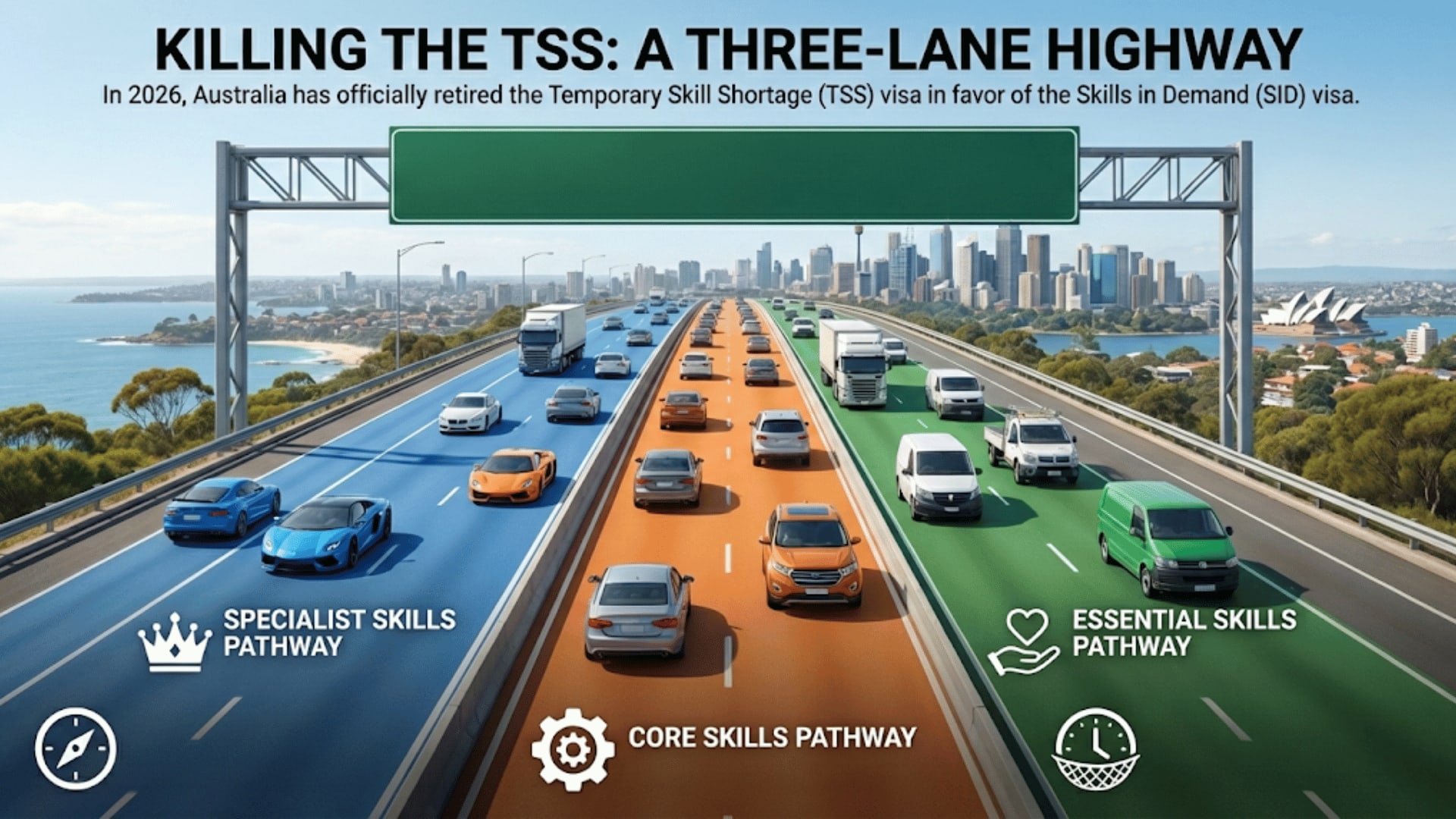
That's what the TSS tried to do. The outcome was traffic jams. Delays in processing, outdated lists of occupations, frustrated employers, and migrants stuck in strict sponsorship arrangements. The SID visa gets rid of this problem by splitting the job market into three lanes: Specialist, Core, and Essential. The main way to do this is by salary. This change is a step away from bureaucratic micromanagement and toward economic signaling.
Instead of asking, "Is this job on the right list?" the system is starting to ask, "How much will the market pay for this skill?"
Why the TSS Didn't Work
The TSS visa was based on a wrong idea: that lists of occupations like ANZSCO could be used to centrally plan the Australian job market. In reality, these lists got old faster than they could be changed. Between review cycles, whole industries changed, especially technology and advanced finance. Employers had to fit new jobs into old categories or wait months for policy changes that never came.
The TSS, on the other hand, treated people with very different skill sets as if they were the same. A cybersecurity expert who made a lot of money and a regional hospitality supervisor had to follow the same strict rules for sponsorship, testing the job market, and short grace periods. The system wasn't just bad; it also made it harder for high-value global talent to find work elsewhere.
The SID visa is proof that the government no longer thought this model would work.
The Specialist Skills Pathway: Pay Is More Important Than Lists
The Specialist Skills Pathway is the biggest change from the old system and is the main focus of the 2026 reforms. Any job that pays more than AUD $135,000 per year (indexed annually) qualifies, regardless of the type of job. The government sees that salary as proof that the skill is really in demand if an employer is willing to pay it.
This is a big change in policy. It takes the place of bureaucratic judgment with market logic. It's easy to see why: employers don't just give out salaries of $135,000 or more unless the job is hard to fill locally and is valuable.
This is a game-changer for fields like technology, fintech, AI, quantitative finance, and advanced engineering. Companies can now look for workers all over the world without having to wait for Home Affairs to recognize job titles that didn't exist five years ago. The promised processing time of about seven days shows that Australia wants to compete directly with the US, UK, and parts of Europe for top talent.
But this path isn't the same for everyone. Tradespeople, machine operators, drivers, and similar jobs are not allowed, no matter how much they make. This shows a quiet but important policy decision: the specialist lane is about global knowledge capital, not just money. The government won't hire someone just because they pay a lot if they think the skill can be developed or controlled in other ways.
The Core Skills Pathway: A New Middle Ground
The Core Skills Pathway is what most people used to call the TSS. It applies to jobs that pay between $70,000 and $135,000 and is based on the new Core Skills Occupation List (CSOL). This is the "middle class" of Australia's system for temporary migration.
This path still requires labor market testing and occupation checks, unlike the Specialist lane. The government is still being careful here, weighing the needs of employers against the need to protect workers in the country. This includes nurses, engineers, technicians, accountants, and many other trades.
The Core pathway is the system's backbone, even though it isn't as glamorous. It is meant to be stable and predictable, not fast and flexible. Some people say that keeping occupation lists could lead to making the same mistakes again. Supporters say that at this income level, the risk of wage suppression and displacement is higher, which is why stricter rules are needed.
It's clear that the Core pathway is no longer pretending to help everyone. It is clearly stated that it is one lane out of three, not the default solution for all shortages.
The Essential Skills Pathway: Important but Politically Weak
The Essential Skills Pathway is the part of the SID framework that people argue about the most. It covers jobs that pay less than $70,000 and is aimed at industries like aged care, disability support, childcare, hospitality, and agriculture—industries that Australia needs but has had trouble staffing at home.
There are a lot of rules about this lane. To stop wage suppression and exploitation, there are sector-specific caps, stricter sponsorship rules, and more monitoring. The government is in a tough spot: it needs to admit that there are real labor shortages without making a permanent underclass of temporary migrant workers.
Some people say that this path could make low pay a permanent problem instead of fixing it. People who support it say that without it, important services would fail. In either case, it shows a political truth: Australia needs these workers, but it doesn't like how much it relies on them.
Portability: A Quiet Change in Power
Portability, not a pathway, is the most migrant-friendly change of 2026. People with an SID visa can switch jobs in the same field without having to get a new visa. They only need to tell Home Affairs.
This one change shifts the balance of power in the workplace. In the TSS, sponsorship often worked as a way to get what you wanted. Because losing a job meant losing their legal status, workers put up with bad conditions. Portability makes the labor market more mobile, which lets wages and working conditions change more naturally.
This makes things more competitive for businesses. It gives migrants a sense of dignity.
The Safety Net for 180 Days
The new 180-day grace period after losing a job is also a big change. Migrants had 60 days to find a new sponsor or leave the country under the old system. In practice, this made redundancy a migration emergency.
The six-month window is realistic in terms of the economy. People get laid off. The end of projects. Companies go out of business. It was never a good idea to treat losing a job as a reason to leave right away; it was just easier for the administration.
This change greatly lowers the risk for families, especially those with kids in school or mortgages that are still being paid off. It makes Australia more competitive with countries that already have longer adjustment periods and shows that the migration system is becoming more mature and focused on people.
Australia's New Migrant Identity
The SID reforms show how Australia wants to be in 2026: a neoliberal economy that is good for workers. The country is willing to give up some freedom, mobility, and security, but only if people can show that they are making a measurable contribution to the economy.
Salary has become a stand-in for value. Market demand has taken the place of bureaucratic prediction. Control hasn't gone away; it's just been moved around.
The TSS visa was killed because it wanted to do too much. The SID visa works because it recognizes that the job market is not a single path; it is a three-lane highway, and not everyone should be required to drive in the same lane.
Need personalized help?
Understanding visa requirements can be complex. Check out our AI-powered tools.
Explore Tools