Colonial Legacy to Economic Asset: India’s Emigration Act Overhaul
Quick Summary
Quick Summary: An analysis of India’s 2026 push to modernize its emigration framework and move beyond the restrictive 1983 Emigration Act.
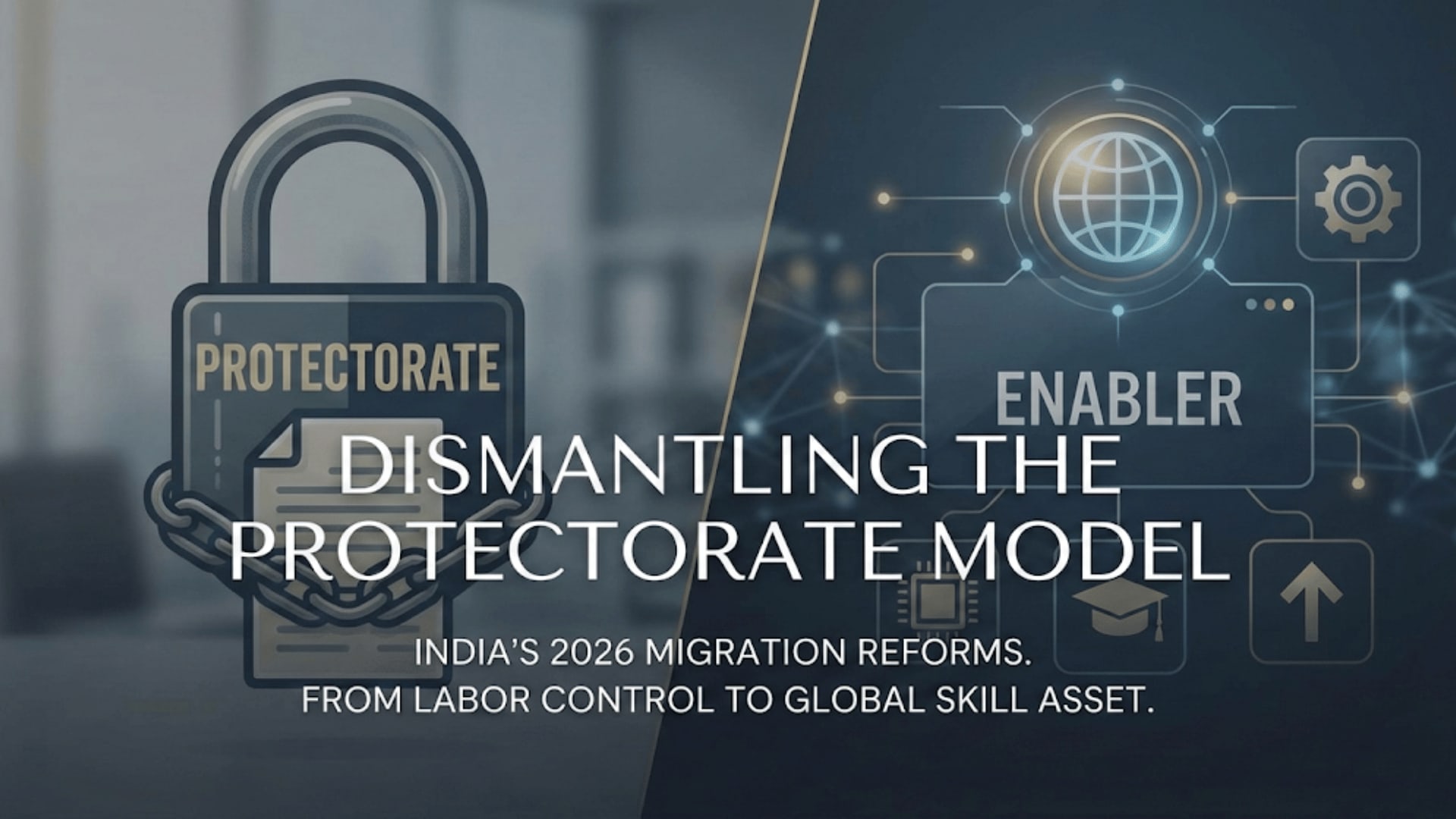
India’s 2026 legislative agenda is focused on a long-overdue overhaul of the Emigration Act, 1983. For decades, India’s outbound migration was governed by a law designed for a different era—one of physical agents, paper contracts, and a focus on unskilled labor in the Gulf. The 2026 reforms, under the proposed Immigration and Foreigners Act, 2025, seek to transform the state’s role from a "protector" of vulnerable laborers to an "enabler" of global skill exports. This is a structural pivot that acknowledges India as the world’s largest source of international talent, from software engineers in Silicon Valley to doctors in the UK.
The Digital Migration Framework
A key detail in the 2026 reforms is the integration of the MADAD and Samadhan portals into a single, blockchain-verified digital identity for every emigrant. This eliminates the need for physical "Protector of Emigrants" (POE) offices for the majority of travelers. By digitizing the "Emigration Check Required" (ECR) process, India is attempting to remove the corruption and delays that have plagued low-skilled migration for years. However, the trade-off is a massive increase in state monitoring; the government now has a granular, real-time map of its global workforce, allowing for targeted tax and remittance policies.
Skill Certification: For the first time, pre-departure training is being linked to international skill standards, making Indian vocational certificates more acceptable in markets like Japan and Germany.
Bilateral Portability: The 2026 goal is to ensure that social security contributions made by Indians abroad can be credited back to their domestic accounts upon return.
Refugee Verification: In a quiet nod to domestic security, the government is also launching intensive verification of refugee claims to ensure that the outbound and inbound migration streams are strictly monitored.
Migration as a Strategic Asset
The quiet shift here is that India no longer views emigration as a "brain drain" but as "brain circulation." The 2026 policy encourages the diaspora to invest not just money, but knowledge back into the Indian economy. For the migrant, the relationship with the Indian state has become more transactional. The state offers protection and digital ease, and in return, it expects a formalized, documented connection to the homeland. The 2026 overhaul is the final step in turning a colonial-era legacy of labor control into a modern, economic-asset management system.
Need personalized help?
Understanding visa requirements can be complex. Check out our AI-powered tools.
Explore Tools