The J-Skip and J-Find: Japan’s Elite Talent Acquisition
Quick Summary
Quick Summary: An editorial on Japan’s move toward elite-only migration pathways and the dismantling of the traditional work-experience barrier.
The End of the "One Size Fits All" Visa The End of the "One Size Fits All" Visa
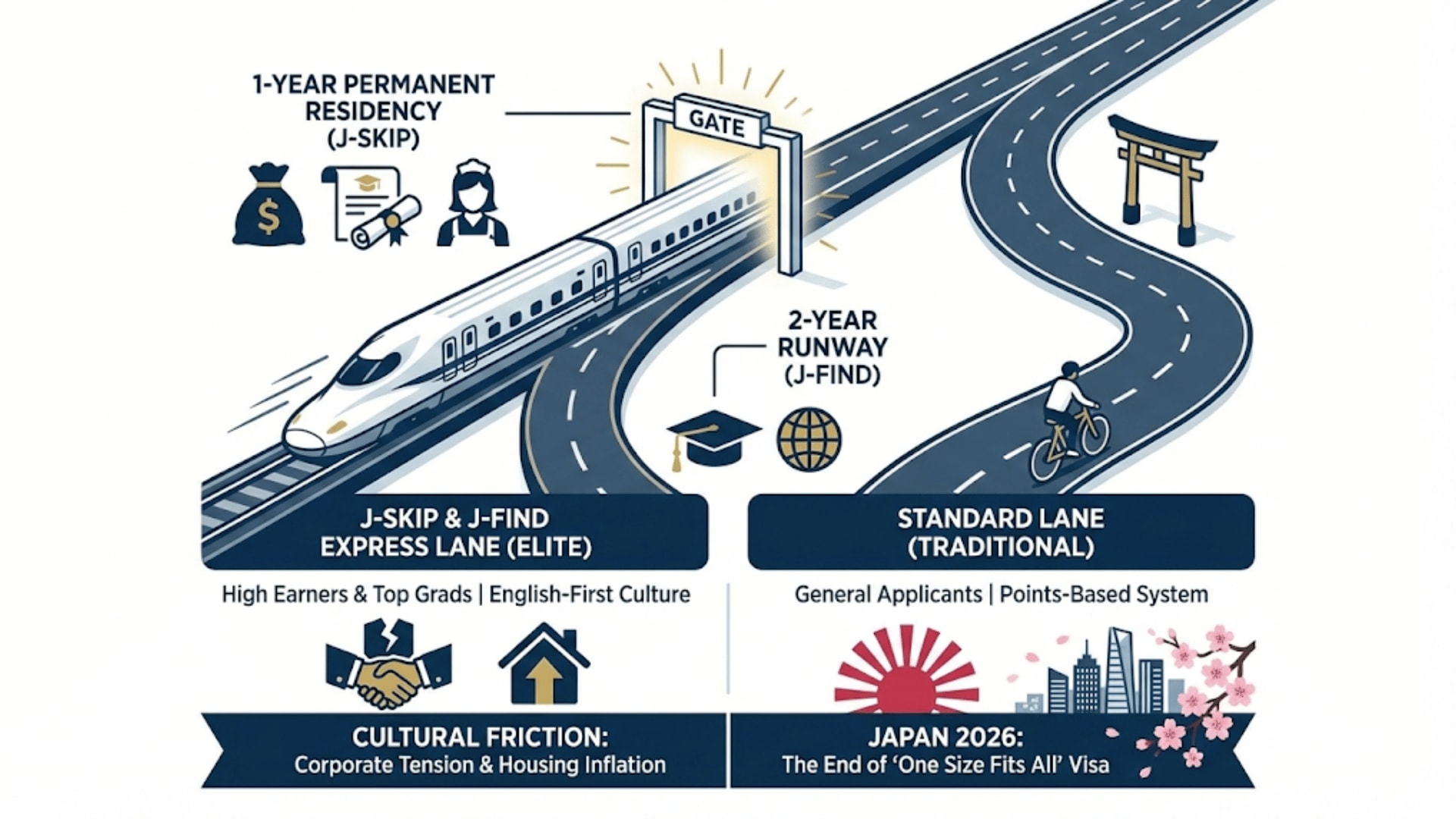
Japan's immigration plan for 2026 is the most fair in all of Asia. Japan's immigration plan for 2026 is the most fair in all of Asia. Japan no longer needs the slow, points-based Highly Skilled Professional (HSP) visa because it has fully implemented the J-Skip (for high earners) and J-Find (for top graduates) programs. Japan no longer needs the slow, points-based Highly Skilled Professional (HSP) visa because it has fully implemented the J-Skip (for high earners) and J-Find (for top graduates) programs. In 2026, there will be a two-speed system: an express lane for the world's best and a slow, standard lane for everyone else. In 2026, there will be a two-speed system: an express lane for the world's best and a slow, standard lane for everyone else. Japan is no longer just looking for workers; it is also looking for people with high brand value. Japan is no longer just looking for workers; it is also looking for people with high brand value.
The J-Skip: Permanent Residency for One Year The J-Skip: Permanent Residency for One Year
The J-Skip is the "Holy Grail" of Asian residency in 2026. Japan now offers a way to get permanent residency in just one year for people who make more than 20 million JPY (about $135,000 USD) and have a master's degree. This is a direct answer to Singapore's ONE Pass and the UAE's Golden Visa. The structural change here is that Japan is finally starting to value "wealth as a stand-in for talent." A high salary is now seen as a clear sign of a person's worth to the state, so there is no need to do complicated point calculations.
The J-Find Runway: Graduates from the top 100 universities in the world can now live in Japan for two years and look for work without any restrictions. In 2026, this is being used as a "gap year for the elite," giving top talent a chance to see Japan before they start working for a company.
Rights for domestic helpers: J-Skip holders can now hire their own domestic staff. This is a big change in culture and policy that is meant to draw in Western and Southeast Asian executives who are used to the Hong Kong or Singapore model. Rights for domestic helpers: J-Skip holders can now hire their own domestic staff. This is a big change in culture and policy that is meant to draw in Western and Southeast Asian executives who are used to the Hong Kong or Singapore model.
The Language Barrier Myth: In 2026, the J-Skip and J-Find paths have an "English-first" culture that isn't very loud. The Ministry of Justice is focusing on the tech and finance sectors, where being fluent in Japanese is less important than being good at technology or management.
The Cultural Friction of Quick Integration The Cultural Friction of Quick Integration
The trade-off for this elite migration is that there is more tension in the Japanese corporate structure. The trade-off for this elite migration is that there is more tension in the Japanese corporate structure. There is a lot of turnover in hybrid companies because a lot of new J-Skip managers don't follow the traditional nemawashi culture of building consensus. There is a lot of turnover in hybrid companies because a lot of new J-Skip managers don't follow the traditional nemawashi culture of building consensus. Also, the housing market in Tokyo in 2026 has seen "expat-premium" inflation, which has made it too expensive for local workers to live in international neighborhoods. Also, the housing market in Tokyo in 2026 has seen "expat-premium" inflation, which has made it too expensive for local workers to live in international neighborhoods. Japan is good at attracting talented people, but it has a hard time getting them to fit into a society that values long-term success and hierarchy over quick money and high pay. Japan is good at attracting talented people, but it has a hard time getting them to fit into a society that values long-term success and hierarchy over quick money and high pay.
In the end, Japan is more appealing than ever to the top 1% of graduates and earners in the world in 2026. Those with the right background can now get past the administrative problems of the past. To be successful, you need to know that the visa process is quick, but the culture is still traditional. The one-year path to residency is a legal reality, but social residency still takes a lifetime.
Need personalized help?
Understanding visa requirements can be complex. Check out our AI-powered tools.
Explore Tools