The Green List 2.0: New Zealand’s Tiered Residency System
Quick Summary
Quick Summary: An analysis of New Zealand’s 2026 Green List updates and the shift from "Straight to Residence" to the "Work to Residence" dominance.
The Targeted Entry of the Green List
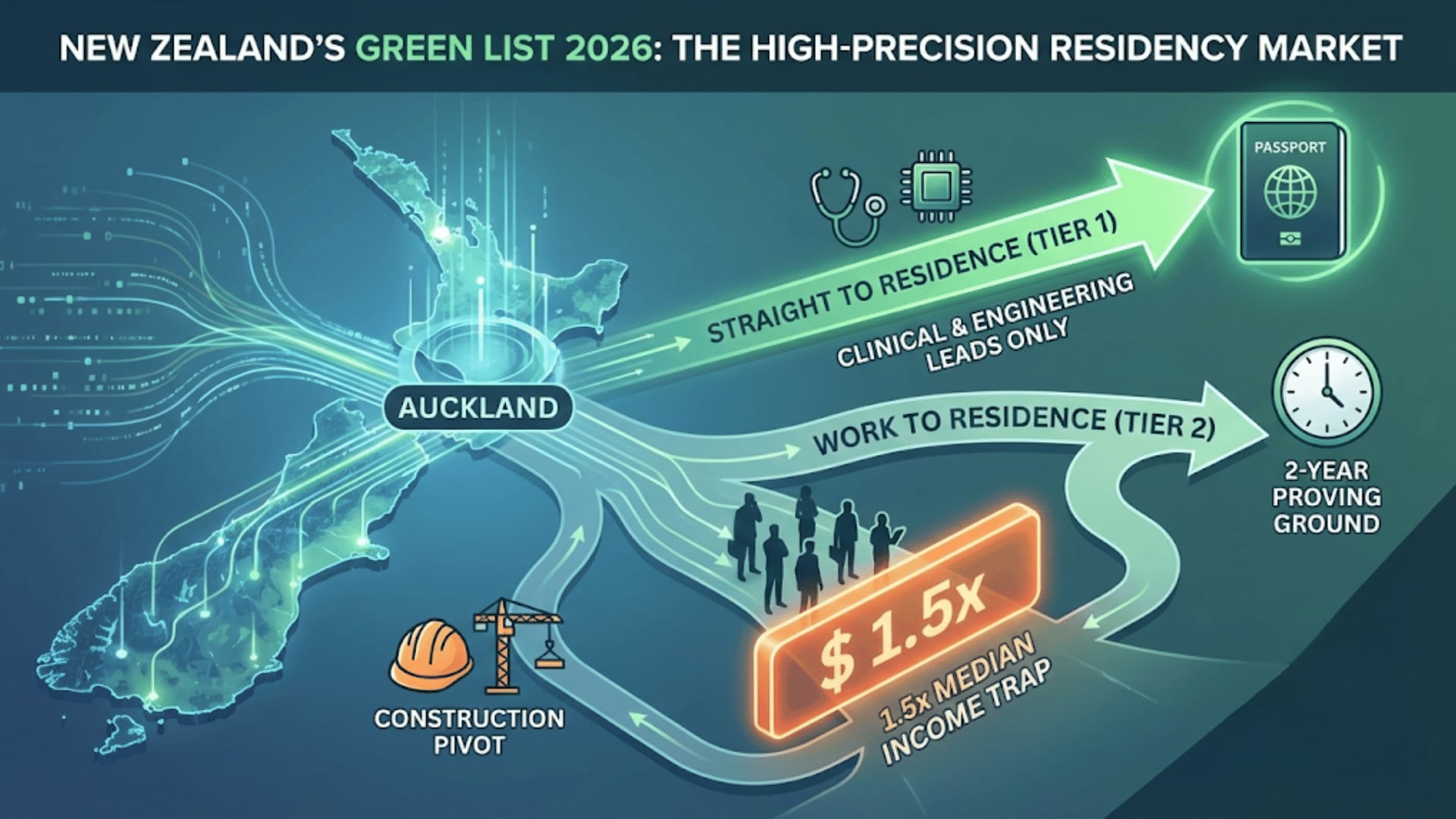
New Zealand’s Green List in 2026 has become the country’s primary mechanism for survival in a global talent shortage. The 2026 update has significantly narrowed the "Straight to Residence" (Tier 1) pathway to exclude almost all middle-management roles, reserving it strictly for clinical specialists and high-end engineering leads. For everyone else, the Work to Residence (Tier 2) is now the mandatory two-year proving ground. This reflects a shift in New Zealand’s philosophy: they no longer trust foreign credentials alone; they want to see the migrant succeed in the local market before granting a permanent passport.
---The "1.5x Median" Income Trap
For many professionals in Tier 2, the 2026 requirement is to earn at least 1.5 times the median wage. In a cooling economy, we are seeing a trend where employers offer the role but cannot meet the salary threshold, leaving migrants on temporary work visas (AEWV) with no clear path to residence. This has created a "residency gap" where thousands of workers are in New Zealand but are ineligible for the security of permanent status. The 2026 policy is effectively a wealth filter, ensuring that only those in the top income brackets of their professions can settle long-term.
- The Construction Pivot: Nearly 20 new construction and infrastructure roles were added to the Green List in late 2025, reflecting the massive national housing push.
- The AEWV Scrutiny: The Accredited Employer Work Visa (AEWV) is now being audited with 300% more frequency than in 2024 to prevent "visa-selling" and exploitation in the Green List sectors.
- The Partner Work Rights: In 2026, partners of Green List holders retain full, open work rights, making New Zealand more attractive for dual-career families compared to the UK’s more restrictive partner rules.
The Regional Bonus Mirage
While the government continues to promote regional settlement, the Green List in 2026 provides no specific "points bonus" for living in rural areas. The system is purely occupation-based. This has led to an unintended consequence: the over-concentration of Green List talent in Auckland. Specialists are choosing the city with the highest salaries to ensure they hit the "1.5x median" requirement, further hollowing out the clinical and engineering capacity of the South Island and regional hubs.
Ultimately, New Zealand in 2026 is a high-precision market. The Green List provides a clear, documented path for those who fit the specific boxes, but for anyone outside those boxes, the path to residency is effectively closed. Success requires a pre-emptive salary negotiation and a focus on Tier 1 roles to bypass the two-year "limbo" of the Tier 2 pathway.
Need personalized help?
Understanding visa requirements can be complex. Check out our AI-powered tools.
Explore Tools